

Silk 3D Florals vs. Synthetic Florals in Luxury Wedding Gowns ($6,000–$15,000+)
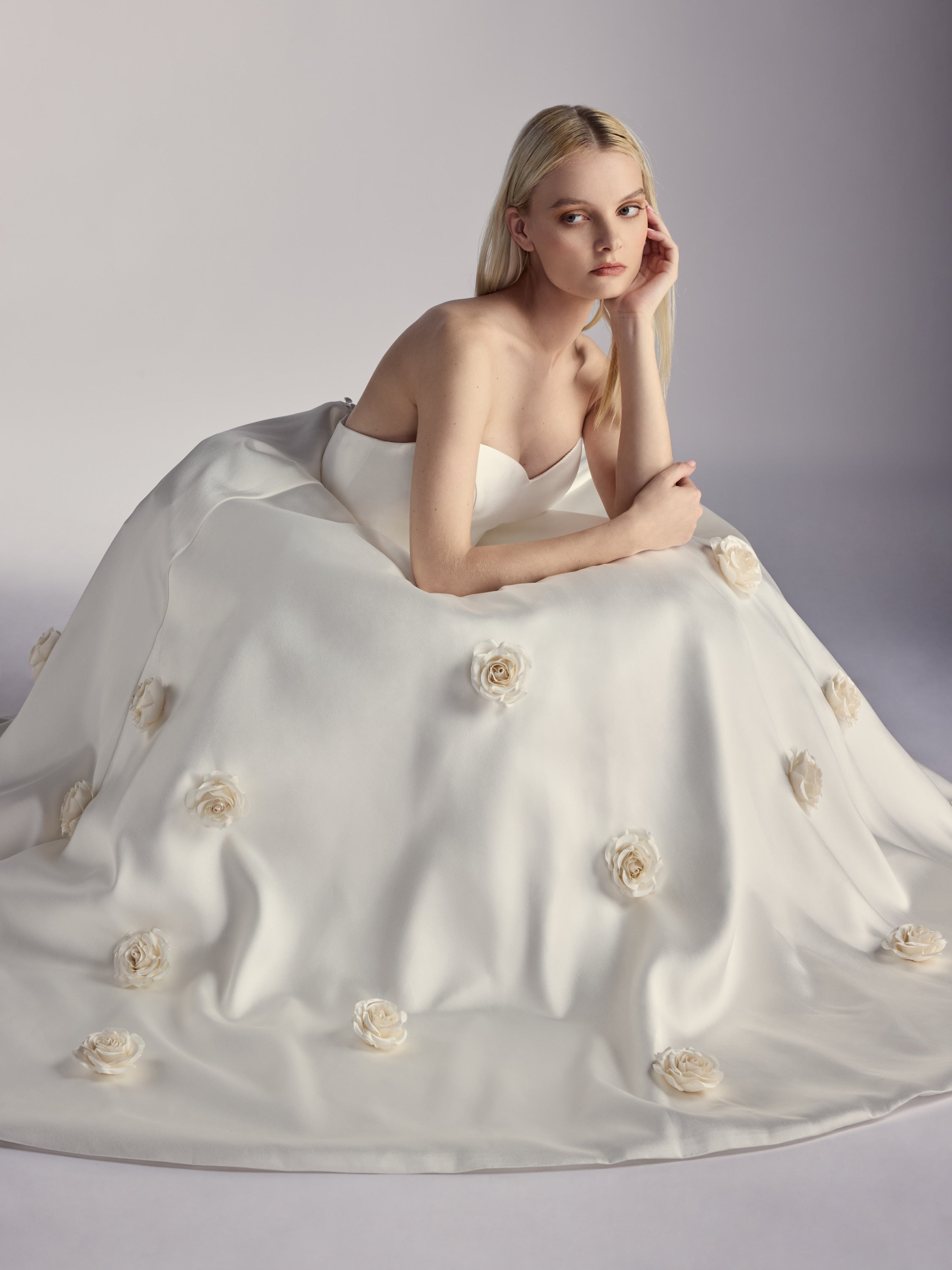
In the modern luxury bridal market, fiber composition increasingly defines the true craftsmanship of a wedding gown.
One question separates genuine couture 3D floral gowns from most bridal designs on the market:
Are the florals crafted from natural silk — or synthetic fibers such as polyester?
This distinction has become increasingly important, as even many heritage bridal houses have shifted toward synthetic floral construction.
What Are Silk 3D Florals?
Silk 3D florals are sculptural embellishments handcrafted from natural silk fabrics, including:
• Italian silk organza
• Double-layer silk organza
• Duchess silk satin
• Silk chiffon
Each petal is individually cut, shaped, and hand-applied to the gown to create dimensional floral structures.
Because silk is a natural protein fiber, it behaves very differently from synthetic fabrics. Silk provides:
• soft, diffused luminosity under flash photography
• fluid, organic movement
• breathable comfort for extended wear
• structural integrity when properly constructed
In couture bridal design, silk allows florals to achieve a refined dimensional softness that synthetic fibers can’t replicate.
Why Silk 3D Florals Are Increasingly Rare
True silk 3D florals are uncommon — even among luxury bridal gowns.
Over the past decade, much of the bridal industry has transitioned toward synthetic floral construction.
Polyester and nylon are now widely used for 3D floral gowns because they allow:
• laser-cut production
• machine-assisted shaping
• scalable manufacturing
Silk behaves differently. It is softer, more delicate, and cannot be industrialized in the same way.
Cutting, shaping, and assembling silk petals requires specialized artisans and careful hand construction.
For this reason, many bridal houses — including some legacy luxury brands — now use synthetic florals even on gowns priced well above $10,000.
The result is that true silk 3D florals have become increasingly rare within the luxury bridal market.
Silk vs. Synthetic: The Structural Difference
| Feature | Silk 3D Florals | Synthetic Florals |
|---|---|---|
| Fiber Origin | Natural protein fiber | Petroleum-based |
| Light Performance | Soft, diffused luminosity | Sharper surface reflection |
| Craftsmanship | Hand-cut and sculpted | Often laser-cut |
| Production Scale | Limited, artisan-led | Highly scalable |
| Market Use | Rare couture applications | Widely used across bridal tiers |
While synthetic florals allow efficient production, silk florals remain associated with the highest level of material refinement.
The La Belle Élégance™ Standard
At La Belle Élégance™, our 3D florals are handcrafted exclusively from natural silk starting from FW26.
Our atelier works with select silk fabrics — including Italian silk organza and duchess silk satin — chosen for their sculptural integrity and luminous softness.
From the FW2026 collection onward, our gowns incorporate:
• handcrafted silk florals
• couture-level petal construction
• dimensional silk layering
• editorial-quality finishing
Our bridal gowns are positioned within the $6,000–$15,000 luxury tier, reflecting the labor-intensive nature of true silk floral construction.
Material Integrity Defines Couture
In bridal couture, craftsmanship begins with material choice.
While synthetic florals dominate much of the modern bridal industry, silk florals remain one of the clearest indicators of true couture-level construction.
For brides seeking a luxury 3D floral wedding gown, refinement begins at the fiber level.
Couture begins with material integrity.
Comments